Rather than a report, most of this "letter" is a diatribe. I've left it in not only because it includes reportage, but because it also offers perspective - not only on this war, but also on why I'm here.
We're now about 36 hours into our cease fire, and we've had two nights of quiet. We haven't yet moved the mattress out of our slightly too narrow SPS, and we haven't yet returned the pictures we took down to its walls, but that's probably more out of laziness and more interesting things to attend to than because we fear that things will flare up again in the immediate future. That they'll flare up seems unavoidable - at least if Israel continues to seek containment rather than an actual change in our relationship to the Palestinians. And as I've noted, that doesn't seem likely, particularly since Bibi and Hamas seem to need, and compliment, each other. I'm starting writing this now, but I expect it will take me at least a day to complete.
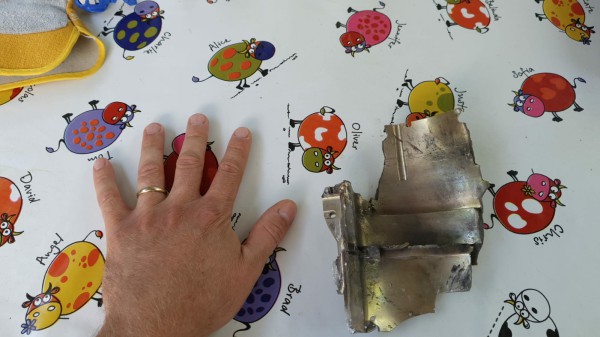
Between my last writing and the cease fire we took to our SPS two or three more times. I don't really remember. I'm not even sure if the sirens we heard were really for us. Our art gallery on the kibbutz has a new exhibit and invitations went out for when it would be open. Shortly after these we also got announcements of closing - sirens had gone off just after opening time and it really didn't make sense to invite people to leave their homes to get to the gallery. I've asked people who have found parts of shells to either save them or photograph them for the archives, and I now have a number of these, including the two here, which will, as expected, become part of our history. This isn't the first time Hatzor has been shelled - the first was back in 1948, though I should make it clear that this time we're not dealing with rockets aimed at us, but instead with debris from the Iron Dome interceptions. (Back in 2008 I reported on an earlier shelling. That one was before Iron Dome so it was the real thing.)

Even on 'erev Shabbat we tend to see the news, which we did yesterday as well, perhaps even more of them than usual because we finished eating earlier than usual. Eitan, who returned the day before from Rhodes, was by us. We ate on the porch and cleared things away once it was really dark. After about an hour of war-related type news the anchorperson remarked, in a tone of surprise, that for the present that was all the "news" and that now it was time for the "magazine" section. This is what getting back to normal sort of looks like.
Pretty much like everybody else, I watch the news from my own perspective. I nod my head in agreement with the interviewees with whose take I identify, and wonder out loud how dumb those I don't agree with can be. Keeping that in mind, I'm pretty sure that a statistical analysis would show an increasingly growing number of formerly high ranking military and security people who have said things that have traditionally been considered the leftist take on our situation. These seem to far outnumber those who tell us that we have to finish off Hamas "once and for all" and are thus more than willing to send in ground troops and continue fighting. Years ago I learned to live with the fact that what were once unacceptable leftist opinions slowly but surely find their way into the mainstream (hell, I remember being told there's no such thing as Palestinians). Sadly, however, this hasn't found political expression where it matters, and our electoral clout has continued to deteriorate. There may be some solace in being able to say "I told you so", but I'd much rather have some actual influence on policy.
One of the signs of the inevitable winding down is that I've been collecting items I want to react to. Since there's less play-by-play to be reported I can somewhat calmly give some of my own political perspective (though of course this is also, and always, part of my play-by-play reporting). So I should perhaps place a warning here. I also got heated up over this war.
I guess it's some sort of masochistic streak - how else can I explain that I devote much more time than is desirable to reading people who don't seem to like me. One piece I came across yesterday in Medium was:
Tessa Schlesinger - I am a Second Generation Holocaust Survivor. Let me Tell You About Israel
who tells us that she is " beyond furious at Israeli actions". She starts out by attempting to "explain" what I guess is the territorial issue:
Who owns Israel — the Palestinians who have always lived there, or the Jews who claim that God gave them the land 3000 years ago?
I have no answer to that question. The Israelis won it by conquest, but they did so in modern times when these actions are not so much accepted. Certainly, the claim that a land belongs to one because a non-existent god gave it to one cannot hold water in the 21st century.
I'm not sure she really meant this, but it seems that what she writes is that in pre-modern times conquest was more acceptable. This seems to be a good way of getting off the hook of some other not-particularly enlightened conquests. I guess she's right about the Jewish claim of the land being God-given (and frankly nobody really claims that the Palestinians "always lived there"), but I get the feeling that ancient Jewish history isn't really her strong point. After all, though this was after Abraham, Isaac and Jacob, the ancient Hebrews also took the land by conquest. Just read the book of Joshua.
I don't know where she gets her statistics from, but under a heading of "Israel Today" she writes:
The correct figure for Jews in Israel is close to 7 million. Does that matter? Probably not, but I found her statistics enlightening for another reason. She suggests that it's only 20% of the Israelis - the orthodox and ultra-orthodox - who are causing all the problems because of their beliefs. Since most pro-Palestinian propaganda I'm familiar with doesn't distinguish between believing or non-believing Jewish Israelis, I really don't think it's fair that I get let off the hook. Shouldn't we all be equally guilty? But of course I quote that previous paragraph for another reason - the "very small number of people" responsible for so much shit. Believe it or not, there really is a great deal of other shit happening in the world that (at least to non overtly anti-Semitic eyes) is being caused by others.Some 41.4 % of Jews in Israel are secular with no belief in god. Another 38.5% are traditional Jews which means they pay lip service to the traditional holidays, and the remaining 20% are orthodox and ultra-orthodox. Bearing in mind that about 4.5 million Jews live in Israel, that means that a mere 900,000 religious Jews have that much influence over Israel in their policies of consistantly taking more land from Palestine. Also bear in mind that there are 8 billion people on this planet. This is a very small number of people to be causing so much shit (sorry, no polite word here) on this planet.
According to Medium, Tessa Schlesinger has a readership of about 250 so there's little reason to devote so much time to her (though I'll return to some of the comments she receives). What interests me more is her quoting from Norman Finkelstein who is a significantly more recognized figure. Schlesinger quotes Finkelstein from a May 12 article on a Turkish website:
“If it is an illegal annexation, Israelis have no right whatsoever in East Jerusalem. They have no rights whatsoever in Gaza. Let me emphasize it, they have no rights of self-defense. They have only one right: They have the right to pack up their bags and leave (Palestine),” he noted.Finkelstein stressed that the recent escalation in East Jerusalem and Gaza should be understood as part of Israel’s long-term, systematic, and planned efforts and history of stealing Palestinian lands, which could be traced back to even before the establishment of Israel in 1948.Discussing the Palestinian resistance against Israel, he maintained that Palestinians have the right to defend their lands and apply to every mean in this end against "the thief state" (Israel), considering the international law and Israel’s inhuman actions.“If you fellow citizens are coming under assault by these land robbers and land thieves, you have every right to join in to resistance,” he said.
Now we're getting someplace. This sort of statement isn't new for Finkelstein, but I guess that I especially like it because of its bluntness. There's no place for conflicting narratives here (let alone accepting the other's narrative). There's only one, and it demands a very clear cut resolution. Not much room for argument, let alone discussion. It's a bit strange to me that Schlesinger apparently doesn't deny the Jews the possibility of a state of their own, yet quotes Finkelstein who makes it clear that they don't.
One responder to the Schlesinger piece, "Sexy Hermit", refers to the part about "a very small number of people to be causing so much shit", and remarks:
Can I get an "AMEN!?" I will say you give a better case than most that Jews do deserve a state of their own, but why did it have to be there?! No room in Australia? Arizona? Nevada? A desert is a desert!
The logic here is fascinating. I suppose that she means that it would be legit for the Jews to take somebody else's land, as long as it's not from the Palestinians (who apparently have better PR than native Australians or native North Americans). A comment such as this definitely suggests that the problem isn't that the Jews took someone else's land, but that the taking of that land back then makes it hard for us to quietly watch Netflix today. (BTW, I've reread the Schlesinger piece a few times and still encounter real difficulty finding where that "better case" she refers to gets presented.)
Another responder merits a lengthy quote. "Jookies in Kail" comments:
I wouldn’t have any issue with the current existence of Israel if it wasn’t doing so at the continued grave expense of Palestine and it’s people. I would LOVE a Jewish-majority homeland to exist, if it wasn’t under the control of Nazi-style Jewish-supremacists who do everything in their power to show the Arab population both within Israel and the Palestinian territories how much they are hated and that their human rights do not matter; that poverty and the iron boot of domination is all that is in their future. That they are NOTHING.
So what’s the solution?? As I see it, since Palestine has suffered under the cruel and bloody boot of Israel for the last 73 years, it should be up to them. First, Israel must be forced to return ALL stolen lands and homes to Palestine and those who were they were taken from and must remove themselves immediately from any and all checkpoints in and around Gaza. All military operations and occupations must cease FOREVER. All walls must be destroyed. Full reparations must be made to all living victims. All Palestinian citizens must have their human rights fully recognized and their civil rights restored. All legal legacies of the apartheid struck from the law books immediately.
The nation’s name should immediately be returned to what it has been from time immemorial, Palestine. Palestinian representation must immediately be granted at 50% or more in the legislature, or based on population, whichever is greater.
Now all of this might indeed sound like a very tall order given the last 73 years of history, but nothing short of that will bring lasting peace in the region, in my assessment. I can only hope once Bibi the mass murderer and absolute thug is removed and hopefully charged with all the war crimes he has committed (and executed if we’re lucky), current and future leaders within Israel and Palestine will have the moral courage, goodwill and resolve to make all this possible (or at least a very great portion of it).
Somehow the magnanimity of the opening part of this comment (it's nice to know that someone doesn't have "any issue with the current existence of Israel") is in severe conflict with the proposed solution. BTW, though Jookies in Kali refers to the last 73 years I'm quite sure that the intent is from much earlier. After all, stealing is stealing and there doesn't seem to be any particular moral reason for there to be a statute of limitations around it.
By this time Mark may have guessed that Jookies in Kail's to my mind rather impractical "solution" (remember, "nothing short of that will bring lasting peace in the region") serves as a good intro for a discussion of Peter Beinart's case for Palestinian refugee return. Beinart's Jewish Currents piece from about a week ago has now been published, in a slightly different version (I don't think there are significant differences) in The Guardian. (BTW, an earlier Beinart article in The Guardian, from 2019, carries a photo of a demonstration where someone is holding a placard "Boycott until the siege of Gaza ends". I'm not a big BDS fan, but I suppose I can go along with that sentiment. The problem is that to the best of my knowledge stopping the siege of Gaza is only one small part of what the BDS movement seeks.)
Beinart makes a number of interesting claims, and I was particularly impressed with his claim that the integration of a vast number of Jews into Israel shows that integrating the Palestinians is also imminently possible:
The same goes for allowing Palestinian refugees to return home. On its face, the notion that hundreds of thousands, or even millions, of Palestinians might return to what is now Israel seems absurd. But in its first four years of existence, Israel – which in 1948 contained more than 800,000 citizens – absorbed close to 700,000 immigrants. At the height of the Soviet exodus in the early 90s, when the Jewish state totalled roughly 5 million citizens, alongside several million Palestinian non-citizens in the West Bank and Gaza, it took in another 500,000 immigrants over four years. The number of returning Palestinian refugees could be substantially higher than that, or not. It’s impossible to predict. But this much is clear: if millions of diaspora Jews suddenly launched a vast new migration to Israel, Jewish leaders would not say that Israel lacked the capacity to absorb them.
It's interesting to me that Beinart uses these statistics to show how apparently easy it would be for Israel to absorb an additional population. More often than not critics of Israel have based their critique toward "western" Israel on its "racist" job of absorption of Jewish immigrants. The discrimination toward Jews from middle eastern countries is still a major topic in Israel today. Alongside many successfully integrated immigrants from Soviet Jewry there's still a very large (and probably much larger) underclass who are still far from actually being integrated - economically or culturally. Jews from Ethiopia rightfully complain that many still don't accept them here. In this light it's strange that Beinart seems to view the integration of what has until now been a belligerent enemy as a piece of cake. I might also add that it seems a bit strange to delegate such a sensitive task to a group which seems to have such a poor record of success.
I agree with Beinart when he writes that it's wrong to demand that Palestinians:
repudiate the very principles of intergenerational memory and historical restitution that Jews hold sacred. If Palestinians have no right to return to their homeland, neither do we.
and calls such arguments "not only unconvincing but deeply ironic". But there's an "all or nothing" element to Beinart which is at the least problematic. Back in Biblical times the Hebrew population of Palestine was primarily in the west bank area, and most of the historically (or Biblically) significant sites are there. I'm quite willing to forgo "returning" to those sites and instead view modern Israel as enough of a "return" to a homeland. I don't see why a similar sort of "return" can't be asked of the Palestinians.
In much of Beinart's writing over the past couple of years he's focused on "myths" in the Jewish narrative. It seems that he's realizing that the stories he was told as a child aren't the truth. So he writes:
The argument against refugee return begins with a series of myths about what happened in 1948, the year in which Britain relinquished its control over Mandatory Palestine, Israel was created, and the Nakba occurred. These myths allow Israeli and diaspora Jewish leaders to claim that Palestinians effectively expelled themselves.Is Beinart's complaint that history is taught primarily as myth, and that Jewish children are taught the Israeli myth while Palestinian children, and perhaps the rest of the world, are actually taught the truth? I'll accept that first part, but the second is rather dubious to say the least. Each side has its myths. It's primarily Israeli historians who have brought a different reality to light, and it should be noted that they've been able to do this because archives have been opened, and because there's been a willingness to go beyond the myth. Other historians examining their own myths would, I trust, go a long way toward helping to end this present conflict. BTW, Beinart's emphasis on myths allows him to disregard what I think is an established fact that the Nakba occurred primarily during a war, started (I don't think Beinart will deny) when Israel's neighbors refused to accept the reality of Israel. Were there expulsions, rather than freely made decisions to leave? Most certainly. But Beinart seems intent on replacing one black/white or good guys/bad guys myth with its opposite, rather than acknowledging a very complex reality.
Though I'm more than willing to believe that Beinart has done his homework and really has learned a lot of history, there's something in the way he writes that suggests that he's only now discovering that the history he was taught was one-sided. It's similar to young Jews exposed for the first time to a less than idealized view of the Zionist movement. Much of what Beinart reports as supposedly new is far from that. Israel's "new historians" "uncovered" an underside to the prevailing history years ago. But I get the feeling that rather than creating a more nuanced understanding of the conflict for him, this "new" information has simply caused him to switch black with white while remaining simplistic. I'm reminded of a vignette I often return to from old JRC Los Angeles days. We were conducting our Shabbat at the home of one of our short-term members, and I think it was Shabbat afternoon when we were discussing problems in Israeli society that Fritzi's mother, overhearing us, exclaimed - "you mean to tell me that there are prisons in Israel?".
Clearly, Beinart is taking a moral stand, and he shouldn't be criticized for that. The issue becomes problematic when we try to translate those morals into a workable reality. Rav Eliezer Shach is reported to have said (in my admittedly poor translation from the Hebrew):
We should be honored that we are the murdered and not the murderers. How bad it is to be a killer, a victor. Better to be defeated. To be of the murdered is determined from on high, but to murder is a corruption of morals.
Shach approached this issue from a perspective of belief. Things (like the holocaust) happen by divine decree. So the assumption being made here is, at its base, very problematic for me. But it's not hard to understand the intent, and even to identify, at least to a certain extent, with it.
But it would be wrong, or at least certainly not very productive, to remain on the moral level alone. Yes, we should be concerned with righting a wrong, but we should also ask why this seems to be the only wrong that seems to have earned worldwide support for being righted. Mark can add to my very short list here of refugee situations which don't seem to garner much international interest:
- A massive and systematic deportation of Serbia's Albanians took place during the Kosovo War of 1999, with around 800,000 Albanians (out of a population of about 1.5 million) forced to flee Kosovo. (see https://en.wikipedia.org/wiki/Population_transfer)
- During the Kurdish rebellions in Turkey from 1920 and until 1937, hundreds of thousands of Kurdish refugees were forced to relocate. (same as previous page)
- The Greek coup and Turkish invasion (1974) resulted in thousands of Cypriot casualties. The Government of Cyprus reported providing for 200,000 refugees. 160,000 Greek Cypriots living in the Turkish-occupied northern region fled before Turkish forces or were evicted; they had made up 82% of the region's population. The United Nations approved the voluntary resettlement of the remaining 51,000 Turkish Cypriots in the south in the northern area; many had fled to the British areas and awaited permission to migrate to the Turkish-controlled area. (see https://en.wikipedia.org/wiki/Cyprus_dispute#Division_of_the_island)
These examples aren't brought in the name of whataboutism, but instead to give a bit of perspective. It's apparently difficult for groups with different identities and histories to live together. Rather than taking the highest possible moral ground it seems to me that it would be more practical for Beinart to seek a just solution that real people can actually live with.
Beinart acknowledges that he doesn't really know how many Palestinians will actually want to return to the historic homeland. Interestingly, I've been coming across the phrase "Palestinian diaspora" quite a number of times lately, and if I may, considering that in the Arab world Palestinians are considered quite westernized and "cultured", maybe we'll find here a parallel to Zionism. Perhaps (just perhaps) we may discover that instead of Palestinian territorialism, what's taking shape now is a sort of Ahad Ha'amian cultural nationalism and in the long run we'll discover (once Palestinian refugees will be permitted to return) that there's limited interest on their part in actually living on the land. And if the story of what's happened to Zionism is an example, maybe once the Palestinians are no longer being screwed over, the Palestinian diaspora will lose interest in what's actually happening in the "homeland".
We've been discussing Beinart in our letters for quite a while. Almost a year ago he wrote why he thought that the one-state solution was the only viable one. His latest take on "return" seems to be a logical outgrowth of that. If we're going to have one state, we'll have to "give" Palestinians the same rights we demand for ourselves. But it seems to me that it's here that two states actually makes more sense and is certainly more workable. At the same time that I tell the Palestinians that an actual return to their previous homes isn't going to happen I have to say to the Jewish settlers in the west bank (who, again, see that area as more their ancestral home than Tel Aviv) that remaining there also isn't workable. I think, BTW, that that's called compromise.
Believe it or not, I have lots more notes, but obviously this is already too long. Maybe another time. Our cease fire is still holding, and who knows, maybe the world is finding other causes to be concerned with. Clearly, my diatribe here is directed primarily toward the left which apparently doesn't want me to be a part of it. In that light I couldn't avoid remembering Amos Kenan's A letter to All Good People from 1968. Mark has a version on his site, and I'm attaching a PDF here. Sadly, more than fifty years later it still rings true.
So is this a summing up? We were at a concert on motz'ei Shabbat, and before it started we were reminded that we should wear our masks throughout. Covid 19 was, again, the issue, and no mention was made of our war, or of our still very new cease fire. (I went to the concert instead of to a demonstration in Tel Aviv.) Our "normal" has never really been normal, and in our desire to return to something at least regular and I guess "livable", we run the risk of actually normalizing it. Hopefully, rather than doing that we might even get a peace process moving again.
sent: May 24, 2021
to War Writing